

Jimmy Cesario
Director, Enterprise Sales

Chris Leffler
Senior Regional Manager, Sales Engineering

Sophie Wang
Senior Product Marketing Manager
Over the past year, federal agencies gained broad access to enterprise AI through the OneGov initiative, at prices unlike any normal software deal. The current OneGov portal lists OpenAI ChatGPT Enterprise at $1 per agency, Anthropic Claude at $1 per seat, and Google Gemini for Government at $0.47 per agency. Those introductory offers begin expiring on September 30, 2026, the final day of fiscal year (FY) 26, which places renewal squarely in the FY27 planning cycle.
With promotional pricing expected to change, agencies must soon decide which platforms to renew, resize, replace, or retire. Making that call requires clear cost and usage evidence. Agencies can prepare by building a clear baseline of what each platform costs, how widely it is used, and what operational value it returns.
To assist with this effort, Datadog Cloud Cost Management (CCM) brings supported AI spend and cloud costs into a shared FinOps workflow. Teams can use that baseline to understand current consumption, assign ownership, detect unexpected changes, and model future spending.
In this post, we’ll show how agencies can:
Build a renewal baseline across AI and cloud costs
Beyond licensing and model-consumption costs, agencies running AI in production also face costs for infrastructure (such as GPUs, storage, and networking), Kubernetes orchestration, ongoing support, and migration.
Different AI services expose cost and usage data through different consoles, bills, APIs, and reporting structures. That fragmentation makes it harder to compare platforms or calculate their full run rate. Agencies need a common baseline before applying possible FY27 pricing scenarios.
Before renewal, that baseline should help answer questions such as:
Which bureaus or program offices use each platform?
Which applications and workflows depend on each platform?
What are the license, model-consumption, infrastructure, integration, and support costs?
How quickly is usage growing?
Which costs would remain if an agency changed vendors?
What would resizing, replacing, or retiring a platform require?
Datadog AI Costs in CCM provides a unified view of supported AI spending. This capability currently supports Amazon Bedrock, Anthropic, Google Gemini, OpenAI, Vertex AI, GitHub Copilot, and Cursor. Agencies can analyze their costs alongside supported cloud infrastructure costs instead of maintaining separate provider-specific reports.
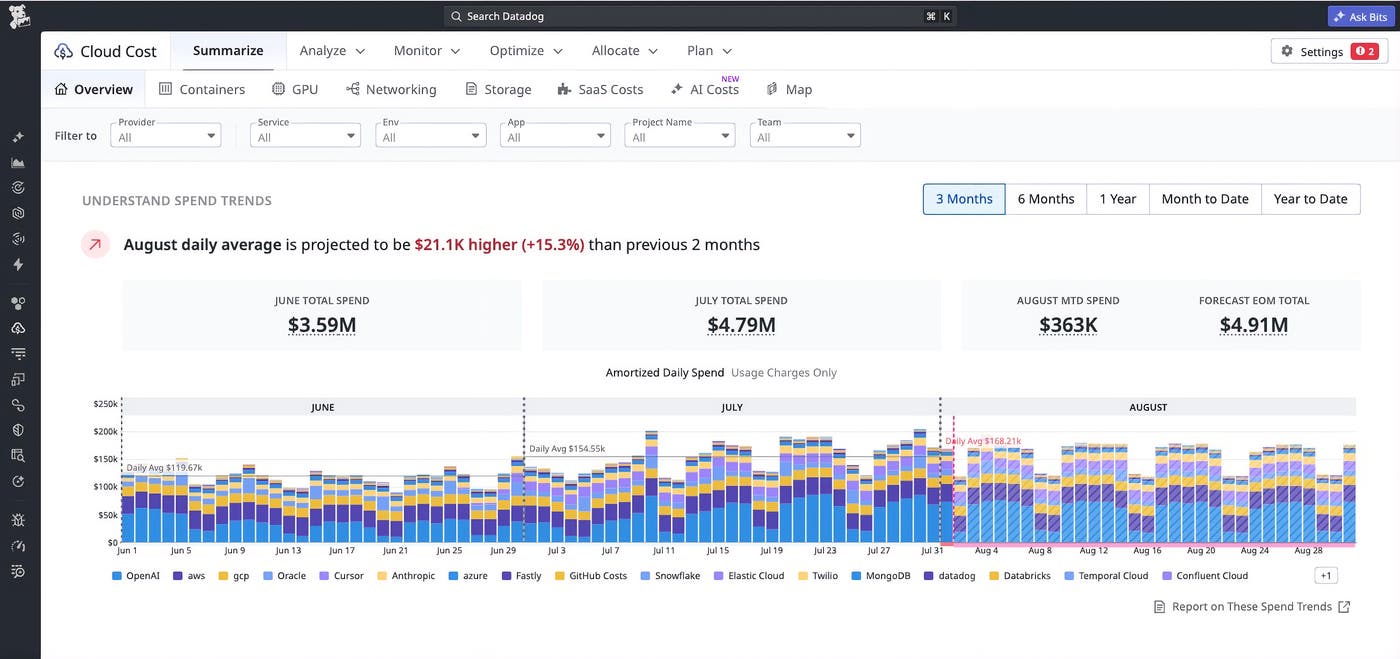
Cost data explains how much an agency spends, while usage data helps explain what drives that spending. Where available, the OpenAI integration can collect account-level metrics for requests and tokens. The Anthropic Usage and Costs integration can ingest token consumption from Anthropic’s usage APIs.
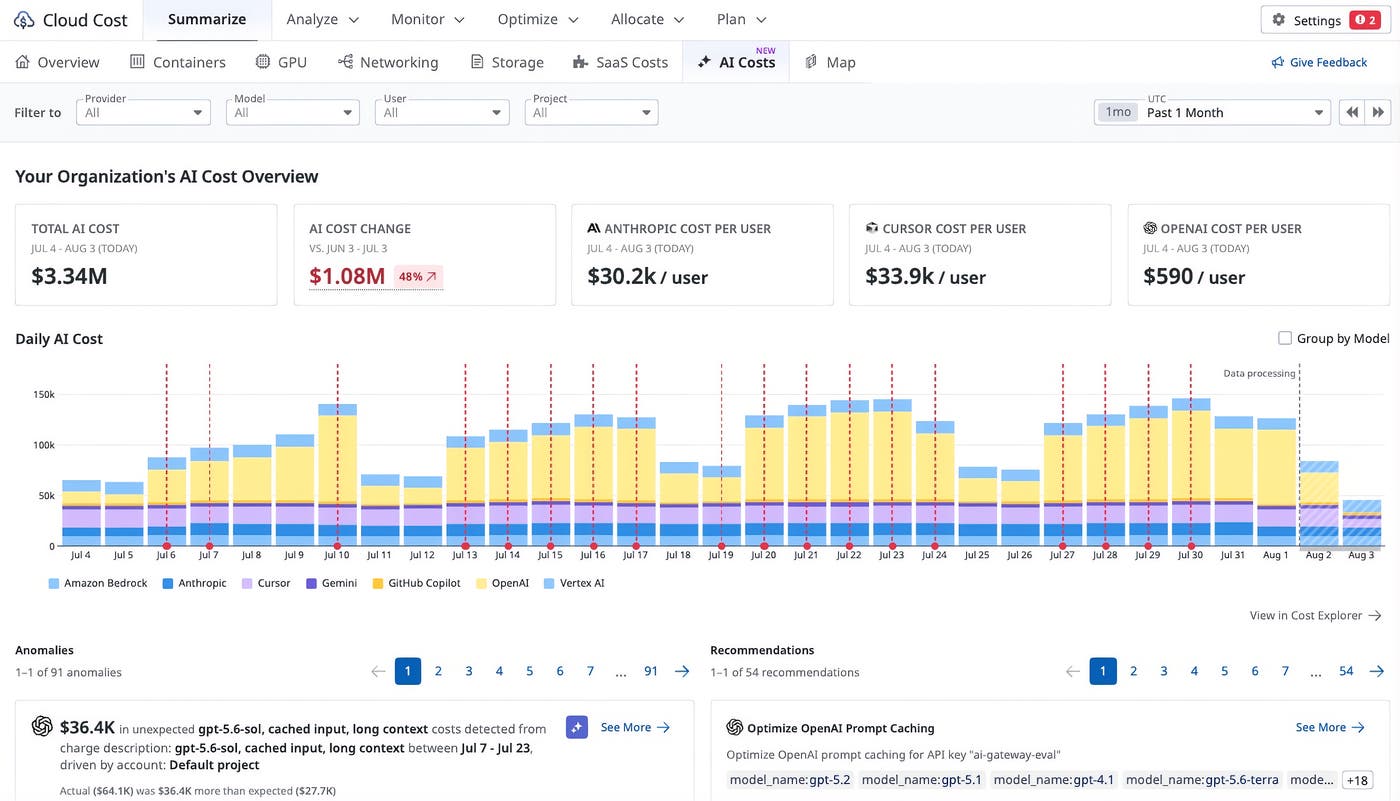
Instrumented applications can add further operational context. The OpenAI and Anthropic integrations can trace supported SDK calls and surface metrics such as token usage, latency, and errors. Agencies can compare those signals with cost trends to build a stronger usage baseline.
Attribute AI spending to the teams that own it
A total AI bill cannot show which investments should grow or shrink. Agencies also need to connect spend with the organizations and applications responsible for generating it.
Datadog normalizes supported AI billing data into a consistent tagging model. Teams can analyze costs through dimensions such as provider, model, project, workspace, application, or environment. This tagging creates a consistent reporting layer across providers.
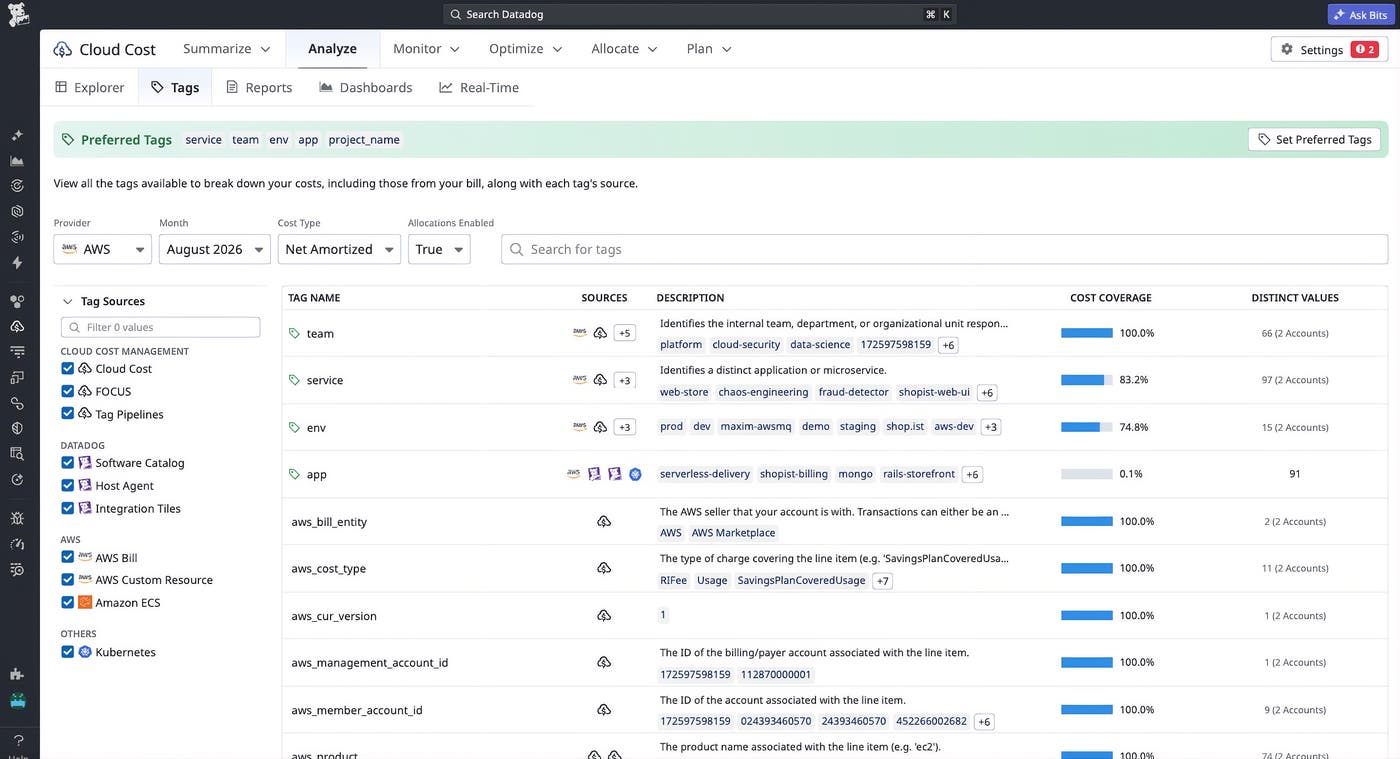
For Anthropic and OpenAI, CCM also provides prebuilt allocation rules that can attribute supported costs to users, workspaces, API keys, and projects. Agencies can then use Tag Pipelines to map those identifiers to their own organizational structure.
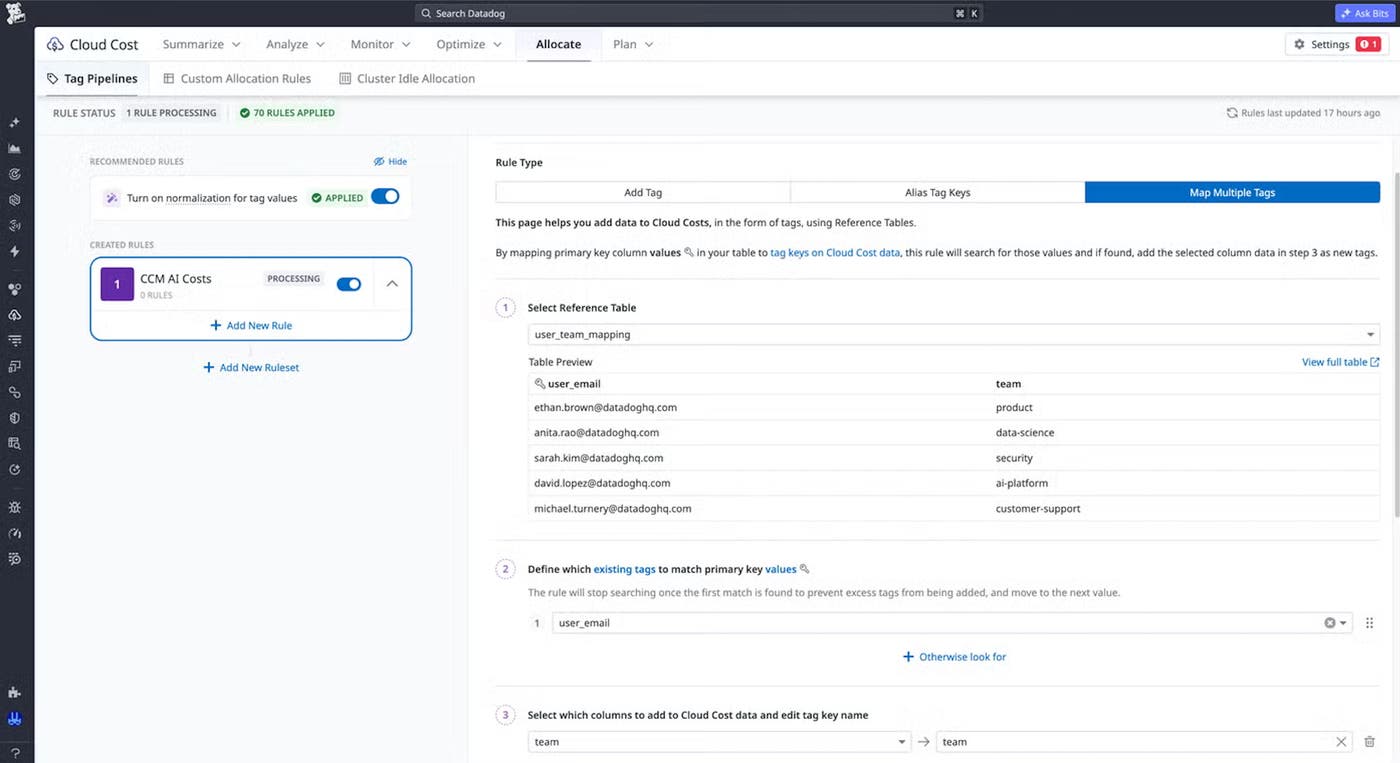
An agency might map AI costs to dimensions such as:
Agency
Bureau
Program office
Mission
Application
Environment
Service owner
That mapping gives government acquisition, FinOps, and technical leaders a shared view of ownership. When spending rises, they can identify which provider, model, project, application, user group, or organizational unit contributed to the increase.
Ownership data can also support chargeback or showback workflows and broader technology management practices. More importantly for FY27, ownership data establishes who should participate in each renewal decision and who depends on the platform.
Detect unexpected AI spending
AI spending can change quickly as pilots become production workloads. Increased token consumption, forgotten API keys, inference workloads, GPU resources, or overprovisioned infrastructure can alter an agency’s run rate before the next invoice arrives. Addressing these cost spikes starts with detecting them as they happen.
Datadog CCM monitors supported cost data and detects unexpected changes. Cost dimensions can help teams investigate which services, accounts, resources, models, or usage patterns contributed to an anomaly.
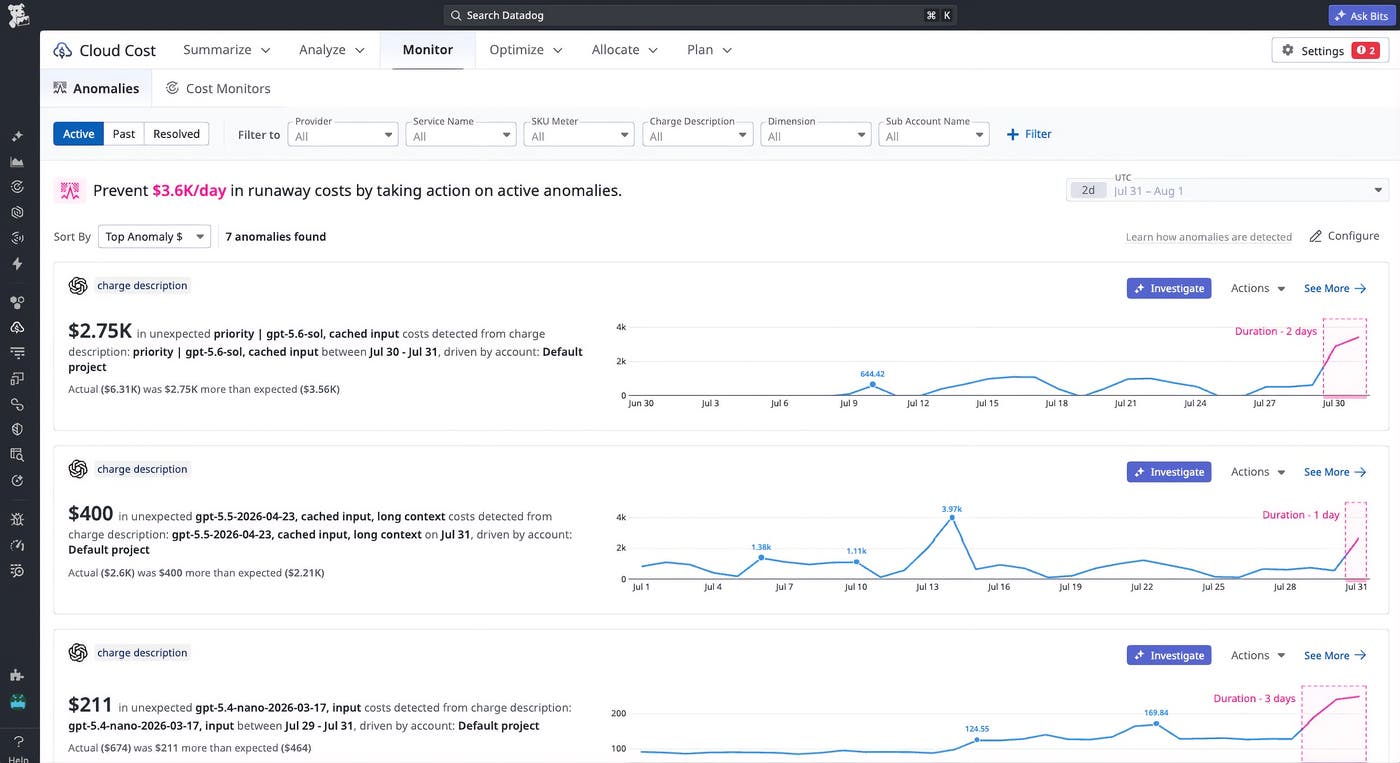
Useful investigations may include:
Runaway inference workloads
Forgotten API keys
Unexpected token consumption
Large supporting data stores
Batch jobs left running
Overprovisioned Kubernetes resources
Finding these changes before renewal is important because current spend should reflect intentional usage. An inflated or unexplained run rate gives acquisition teams a weaker baseline for estimating FY27 requirements.
Regular consumption review also supports sound procurement practice. The Buy AI guidance advises agencies to account for usage-based costs and apply appropriate controls as they procure AI services.
Forecast FY27 spending under new pricing
Historical spend alone cannot answer what an agency may pay after a promotion ends. FY27 planning requires current usage data, a forward-looking estimate, and pricing scenarios supplied through the acquisition process.
Datadog CCM can forecast future costs from historical spending patterns. Teams can compare forecasted and actual spending, then assess those projections against possible renewal terms.
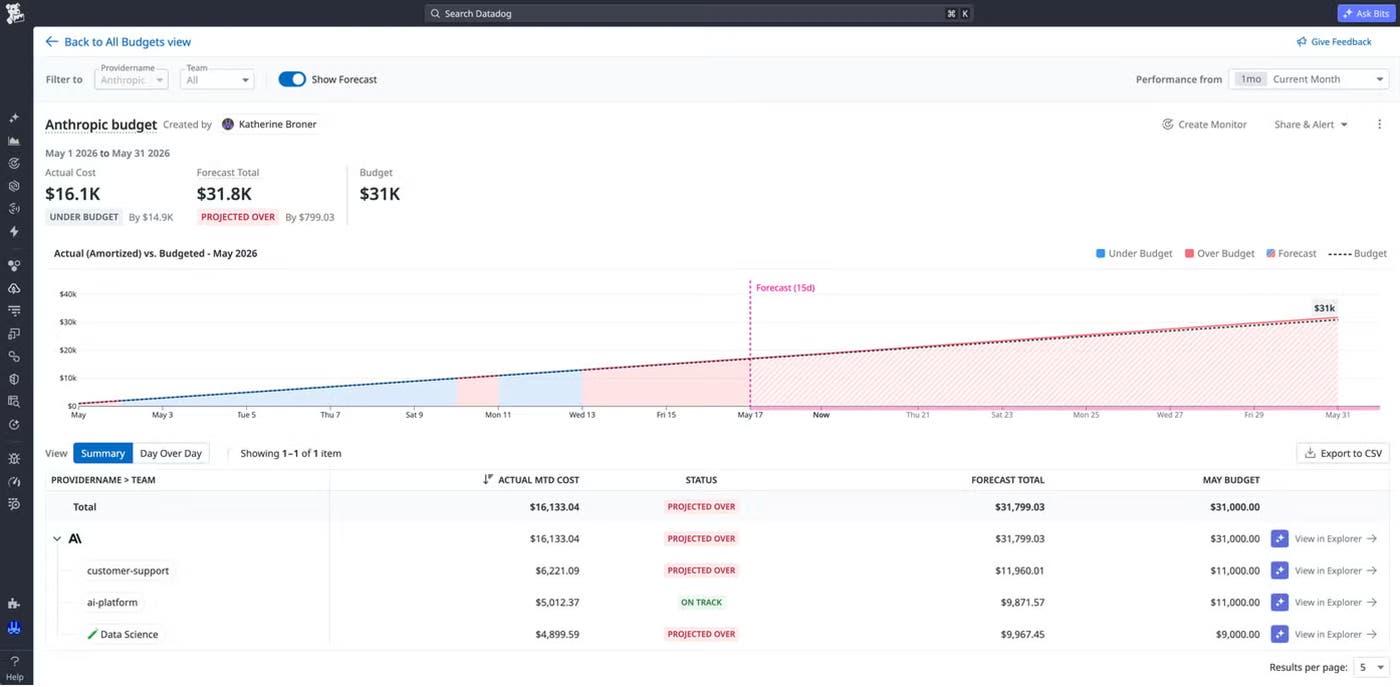
CCM budgets can show actual and forecasted spend together. Hierarchical budgets can also mirror organizational structures, helping agencies assess spending across parent and child groups such as departments and teams.
Teams can use budget views to track:
Actual versus forecasted spend
Remaining budget
Projected period-end costs
Budget health
Threshold-based budget monitors
Recurring cost reports
These forecasts establish a usage-based starting point, rather than a prediction of future contract prices. Acquisition teams still need actual proposed terms to model renewal scenarios.
For example, an agency can apply candidate per-user or consumption rates to observed usage. Teams can then compare scenarios for full renewal, reduced access, workload migration, or platform retirement. Basing these scenarios on real usage data helps ensure that agencies forecast what they’ll actually spend.
Evaluate operational value and dependency before renewal
Cost is only one part of the FY27 decision. Agencies also need evidence showing whether a platform delivers enough operational or mission value to justify continued spending.
A useful evaluation connects spending with measurable outcomes. Depending on the workload, those signals might include application performance, reliability, transaction volume, service efficiency, error rates, or other agency-defined mission measures.
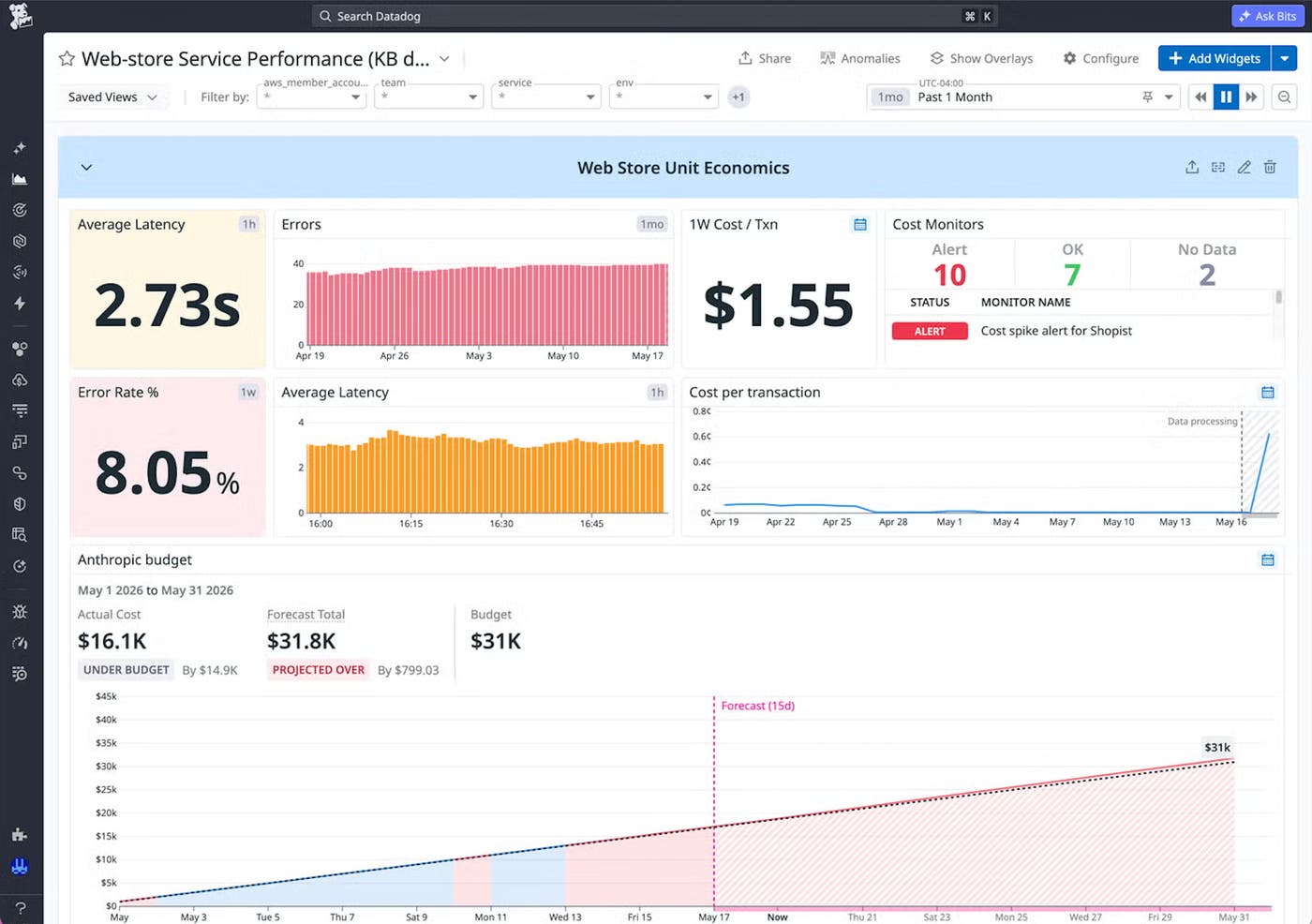
Datadog can place cost data alongside telemetry data from products and features such as Infrastructure Monitoring, Application Performance Monitoring (APM), Log Management, and Service Level Objectives (SLOs). The operational context that these features provide helps agencies evaluate an AI investment beyond its invoice.
Agencies should also weigh operational value alongside dependency. Teams may have adapted workflows, prompts, integrations, training, and institutional knowledge around a platform during the promotional period. Those dependencies can make switching more expensive even when the agency retains control of its underlying data.
A March 2026 analysis by GW Law Professor Jessica Tillipman examines promotional AI pricing through the Federal Acquisition Regulation’s buying-in framework. The analysis argues that agencies should consider life cycle costs and dependencies before promotional periods end. More broadly, the analysis provides a useful framework for treating the promotional period as an evaluation window and preserving options before renewal.
Agencies can document dependencies that Datadog cost data cannot measure directly, including:
Workflows built around a particular platform
Prompts, templates, and reusable instructions
Integrations with agency systems
Training and change management investments
Migration effort and switching requirements
Government-controlled copies of important materials
Combining that inventory with cost, usage, ownership, and operational evidence creates a more complete renewal record. It also helps teams distinguish valuable adoption from dependency that has accumulated without deliberate evaluation.
Prepare for the next phase of federal AI adoption
The OneGov promotions gave federal agencies an unusual opportunity to experiment with enterprise AI at nominal access prices. The US General Services Administration (GSA) says the limited-time AI offers alone have saved the federal government approximately $1.4 billion, demonstrating the scale of adoption and value these discounts have created.
As GSA works with vendors on potential extensions and new offers, agencies may not yet know exactly what FY27 pricing will look like. But they can prepare for whatever comes next by establishing evidence for cost, usage, ownership, operational value, and dependencies. A well-supported baseline can help them size renewals more deliberately, defend FY27 budgets, and preserve practical options as procurement terms change.
Schedule a personalized demo with a Datadog public-sector expert to see how Cloud Cost Management can support AI cost analysis and renewal planning. And if you’re not yet a Datadog customer, you can sign up for a free 14-day trial.
